
SOCIAL NETWORKS
- UA
- EN

Optimal conditions for spraying: from +10°C to +25°C. But there are exceptions: some products work better at lower or, on the contrary, higher temperatures. Check the information for each product. Or contact an official representative
THE MAIN RULE: each product, and especially each tank mix, must be approached individually.
WARNING: Deviation from optimal conditions (for a product or tank mix) can lead to a significant reduction or complete loss of treatment efficacy.
CLEANLINESS − the absence of organic and mineral impurities in the water: plankton, algae, particles of soil and clay. These are natural sorbents that reduce the action of plant protection products.
HARDNESS − its saturation with calcium and magnesium salts. This indicator can be measured in a laboratory or with portable devices. The problem of excessive water hardness can be solved by adding special substances.
pH LEVEL: − different active ingredients react differently to the pH of the solution, and this must be taken into account when composing tank mixes. For details, check each product in the catalog.
The optimal relative air humidity should be 70-80%
At air humidity below 30%, it is recommended to consult a manager
Dirt, soil particles, plant residues and algae can clog filters, nozzles, etc.
The efficacy of products can be significantly reduced in the presence of organic impurities. THEREFORE IT IS IMPORTANT TO USE ONLY GOOD-QUALITY, CLEAN WATER!
Before preparing the working solution, a preliminary mix should be carried out in a separate container to check the compatibility of the tank-mix components.
The use of chemical plant protection products increasingly provokes the emergence of resistance to their action. This leads to a continuous increase in the chemical load on nature and creates new economic and environmental problems. Agronomists, seeking to broaden the spectrum of action, often choose tank mixes. There are various models of pesticide use that allow the possibility of negative consequences to be reduced, one of which is the correct use of tank mixes.
Multi-component products offer a certain convenience of use. However, the fixed ratio of active ingredients in such products often does not allow prompt response to the actual phytosanitary state of the field. An alternative is tank mixes of single-component products.
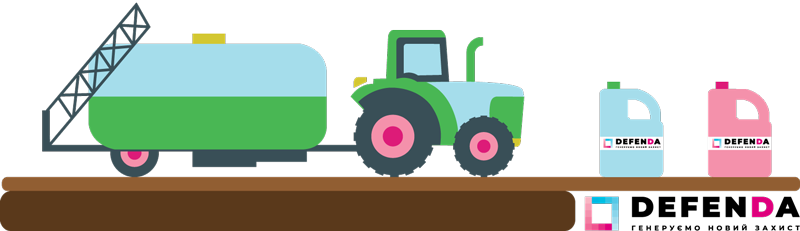
The selection of components plays a very important role. When planning the composition of tank mixes, one should take into account the harmful objects, the crop's growth stage and the application timing. It is also necessary to ensure that the crop being treated is not under stress at the time of treatment.
Only compatible products should be used to prepare tank mixes. Incompatible pesticides are those which, when mixed, change their physical properties, have a phytotoxic effect on the crop or reduce efficacy against harmful objects. In addition to the active ingredient, a product contains solvents, preservatives, antioxidants, stabilizers, various surfactants, corrosion inhibitors, thickeners, substances to reduce evaporation, pH regulators, etc.
Using tank mixes of pesticides has a number of significant advantages:
Mixing anionic and cationic surfactants can trigger coagulation of the emulsion and suspension. The same reaction can occur when an unsuitable sticking agent or a chelated micronutrient fertilizer is added.
Joint use of contact and systemic herbicides is undesirable, because plant tissue, under the action of a contact product, reduces its physiological activity, which in turn hinders the uptake of the systemic herbicide. Moreover, the efficacy of the latter in a mix is lower than on its own. Therefore, systemic herbicides are applied first, and contact ones afterwards.
These are packets of pesticides that dissolve together with their contents in the sprayer tank. If one of the tank-mix components is water-soluble packets, then preparation of the tank mix begins with them.
These are concentrated suspensions of active-ingredient particles.
Aqueous solution (SL), aqueous concentrate (SL), water-soluble concentrate (SL) — these products are added to the tank mix last, because they have very good solubility.
Water-dispersible granules (WG), wettable powders (WP). Water-dispersible granules are dissolved first, since they contain binding water-soluble substances that hold the powdery particles together in the granules. At this stage, the presence of oil in the sprayer tank is undesirable, as the oil will coat the granules and prevent the binders from dissolving. Separation of the solution in the sprayer tank may occur. Preparation of a stock (mother) solution is advisable. It also requires constant agitation.
By its properties, oil forms insoluble compounds with the active-ingredient particles. Therefore, if the dry substances have not fully dissolved, adding oil-containing substances can lead to separation of the liquids and the formation of a thick sediment in the sprayer tank. If oil-containing components are added to a tank in which fertilizers are already dissolved, "coagulation" of the solution will occur.
They improve the adhesion of product formulations, enhance the ability of the working solution to stay on the plant surface, accelerate the penetration of pesticide active ingredients and reduce the surface tension of the working solution. They are added to the tank mix last.
It should be remembered that not all fertilizers and micronutrients mix with plant protection products. For example, you must not mix oil-based products with fertilizers containing boron (B), or calcium fertilizers with fertilizers containing phosphorus (P) and sulfur (S), iron (Fe), zinc (Zn), magnesium (Mg) and manganese (Mn).
Mixing two or more complex liquid fertilizers is INADVISABLE — each of them is already balanced in composition on its own.
The use of growth regulators requires increased attention. When mixing several growth regulators, you may not get the expected result, or may cause a phytotoxic effect on We recommend consulting a company representative beforehand.
When preparing tank mixes and mixing different products and fertilizers — each case is unique! The water used to prepare the working solution, after rain or a change in temperature, can negatively affect the quality of the tank mix. The reaction of the active ingredients in a tank mix can be varied and unpredictable!

Before using a product or fertilizer, read the label carefully. On the labels, manufacturers indicate application features and other information.

Before filling the products into the sprayer tank, carry out a compatibility test. Into a glass container with a lid (a jar) pour water (the water must be from the same source as in the sprayer), add the products — the tank-mix components in ratios corresponding to the application rates. Stir thoroughly. The homogeneity of the mixture is assessed visually twice: immediately after stirring and after 30 minutes, letting the mixture settle.

Mixing two chemical substances leads to a certain physico-chemical reaction, either expected and positive, or unexpected and unpredictable. The result of mixing two or more incompatible products may be precipitation in the form of a cheese-like mass, clouding of the solution, or the liquid may heat up or cool down; the reaction may be accompanied by gas release, abundant foaming, or separation of the components in the tank. If, as a result of a trial mix of products, a mixture forms that separates within 30 minutes but is easily re-mixed on stirring, then such a working solution can be used in the field provided there is constant agitation in the sprayer tank. If, as a result of a trial mix, a heterogeneous mixture of oil, sediment, flakes, etc. forms — then such mixtures are not fit for use. Moreover, such heterogeneous mixtures are distributed unevenly over the plants, causing burns and phytotoxicity.

We prepare stock solutions if one of the tank-mix components is in the form of a wettable powder or water-dispersible granules. In the tank we combine only the stock solutions of the products!

If you have any questions, contact a company representative.

Set the application rates depending on the spread and harmfulness of the target objects.

We prepare the working solution immediately before use. The ready working solution or residues after application must not be left in the sprayer.

The water must be clean, free of silt and foreign impurities, at a temperature no lower than 10°C. Using cold water reduces the solubility of products and increases the risk of reduced efficacy.











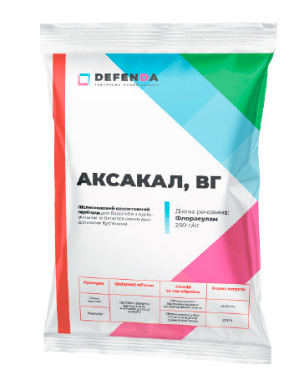
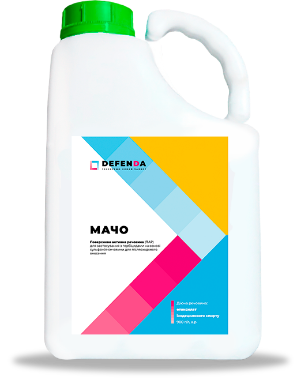
In spring, weeds such as wild mustard and fat hen appeared in winter wheat crops. We apply the herbicide SHERIFF (tribenuron-methyl) WG + surfactant MACHO (isodecyl alcohol ethoxylate 900 g/l) at a rate of 25 g/ha + 200 ml/ha with a spray volume of 200 l/ha of water, and this is enough. On another field a group of weeds appears, such as catchweed bedstraw and volunteer sunflower (IMI). To deal with this problem, we add the herbicide AKSAKAL (florasulam 250 g/kg) WG at a rate of 25 g/ha with a water spray volume of 200 l/ha, as in the previous case.
Choose which cookie types to allow. Your choice is saved for 12 months and you can change it anytime via the link in the footer.
Detailed cookie list: Cookie Policy· Data processing: Privacy Policy
Technical questions: k.maltsev@lnz.com.ua
